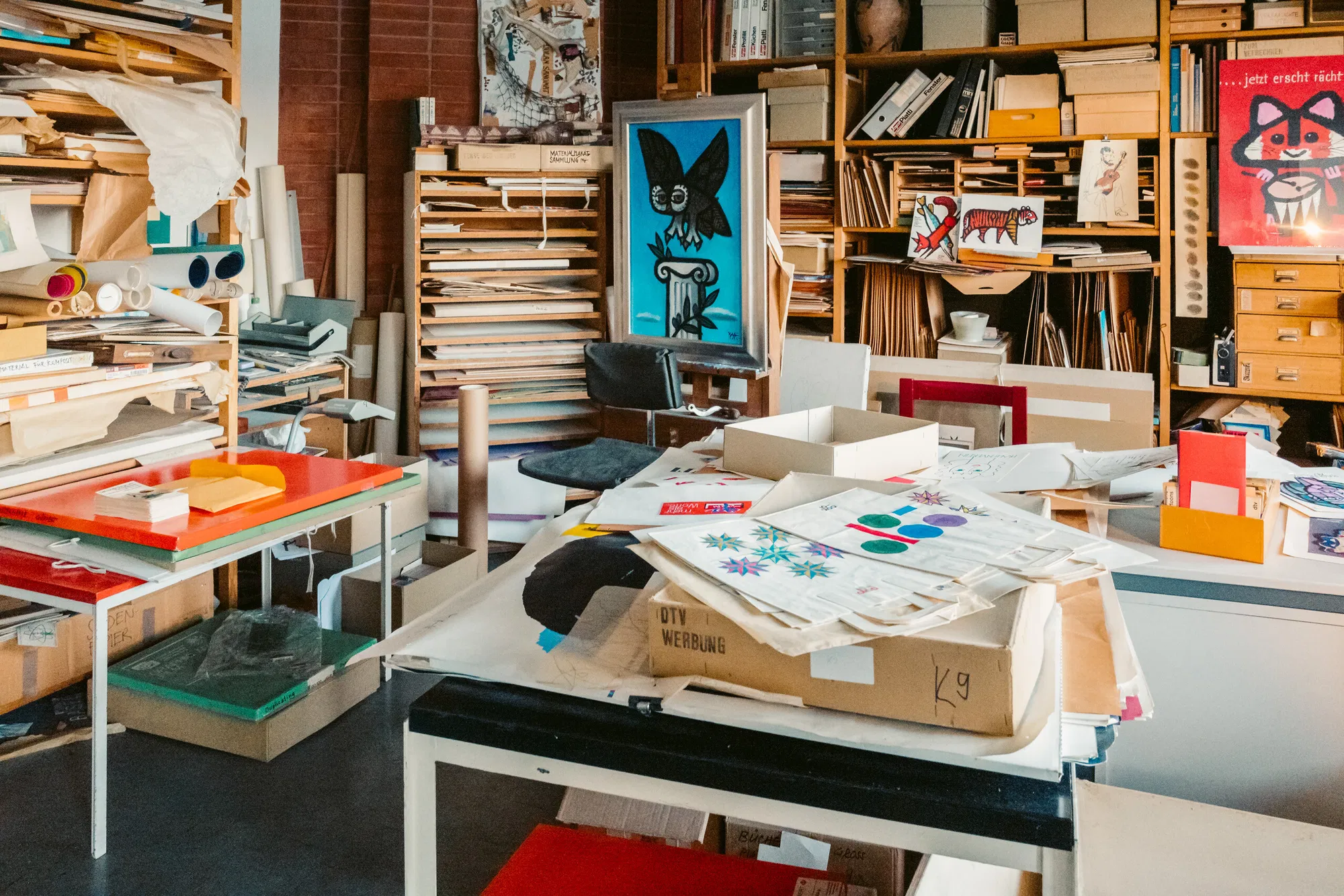
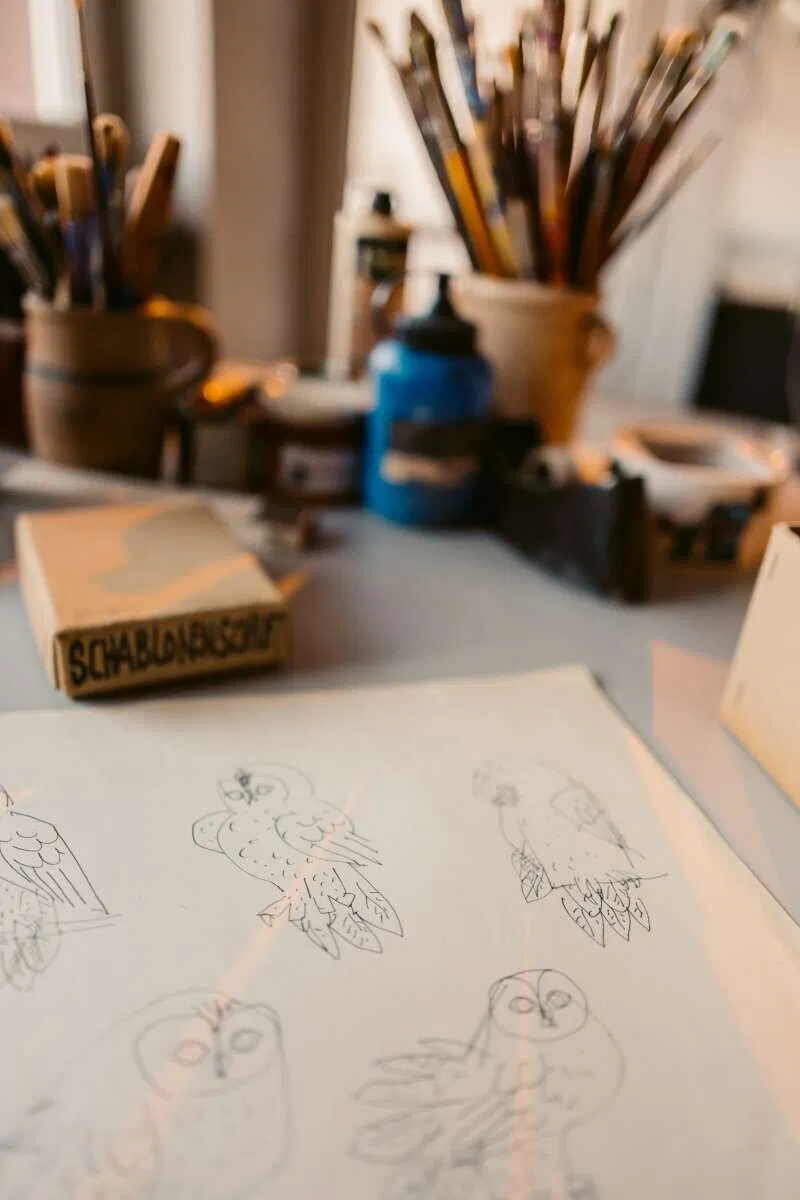
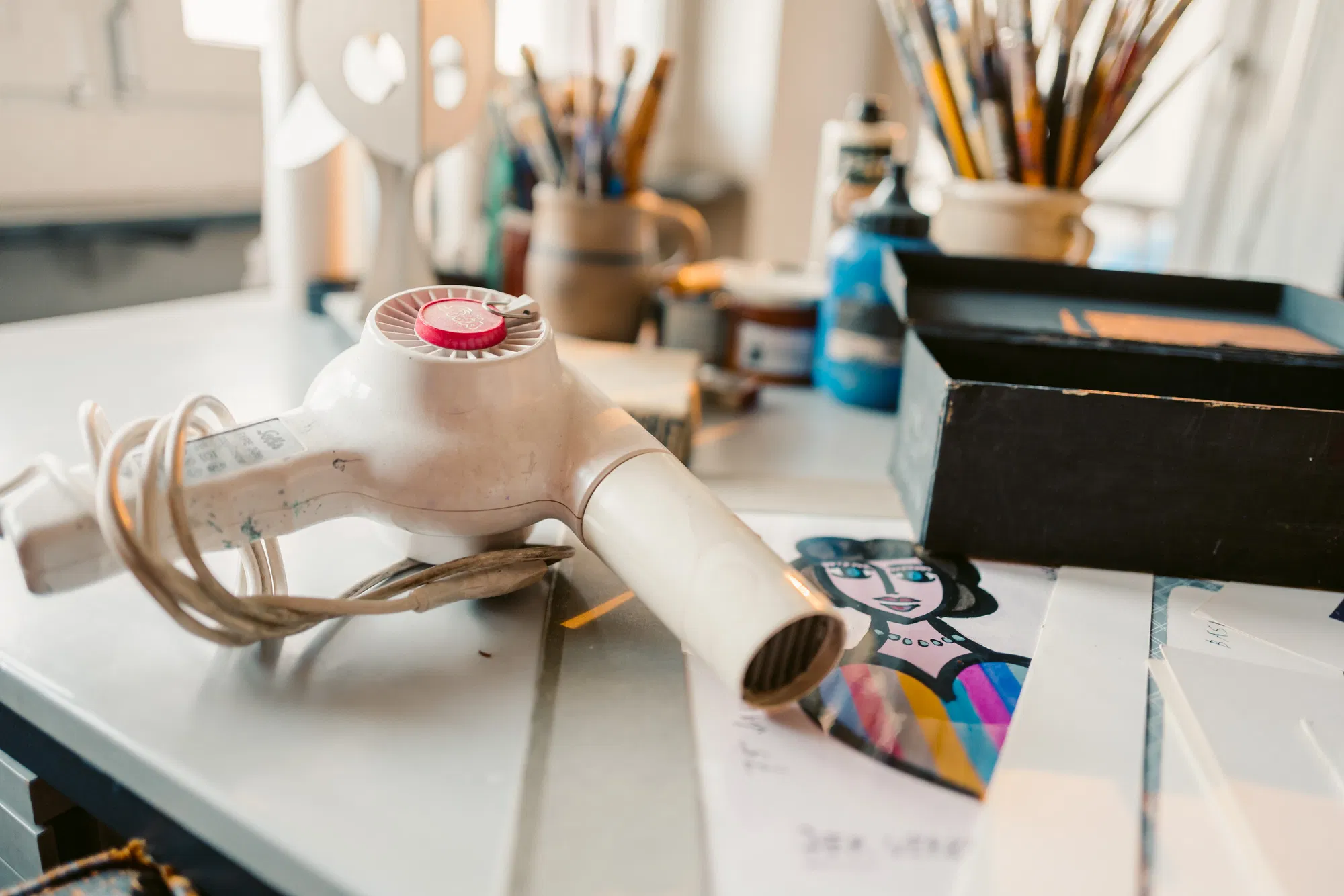
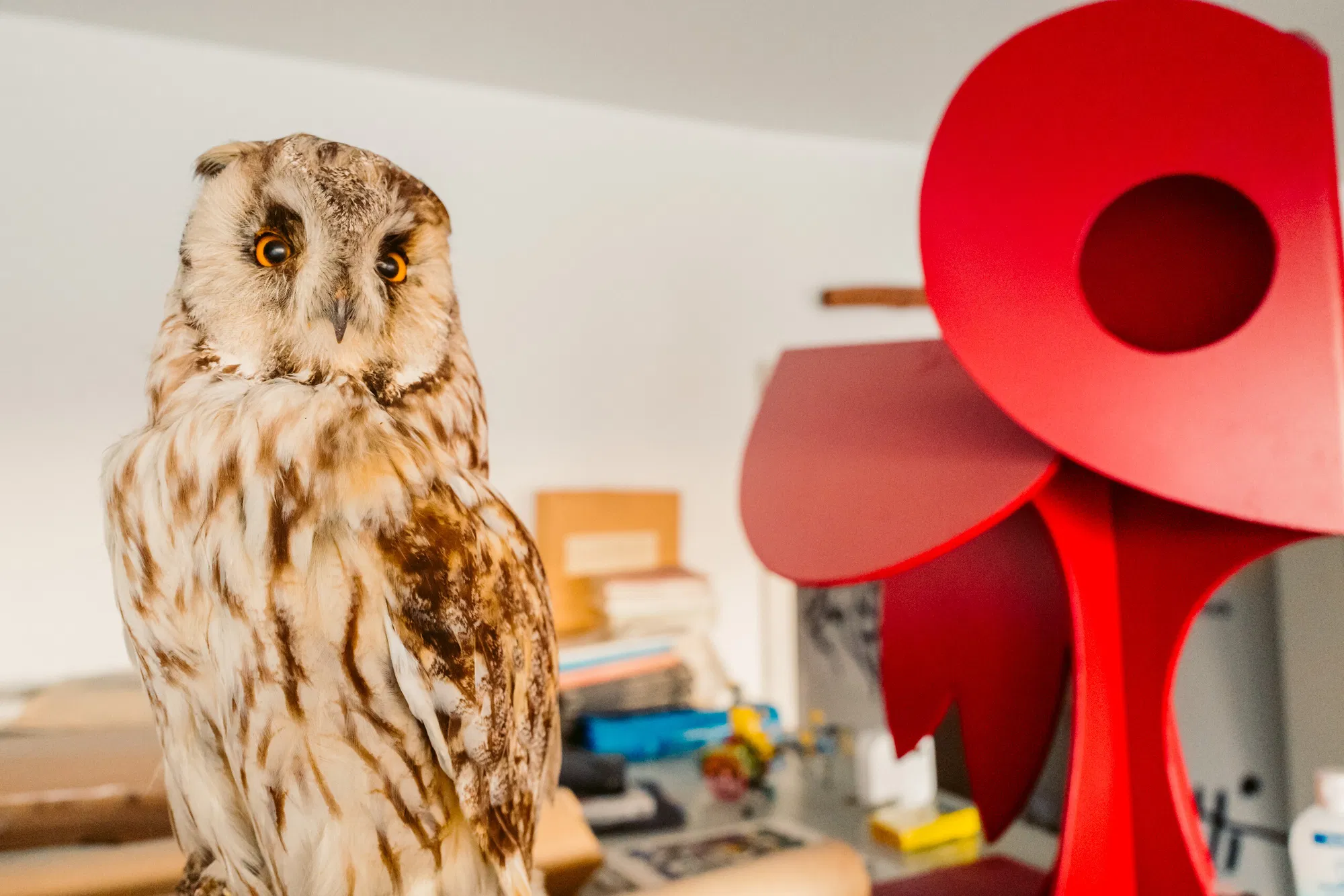
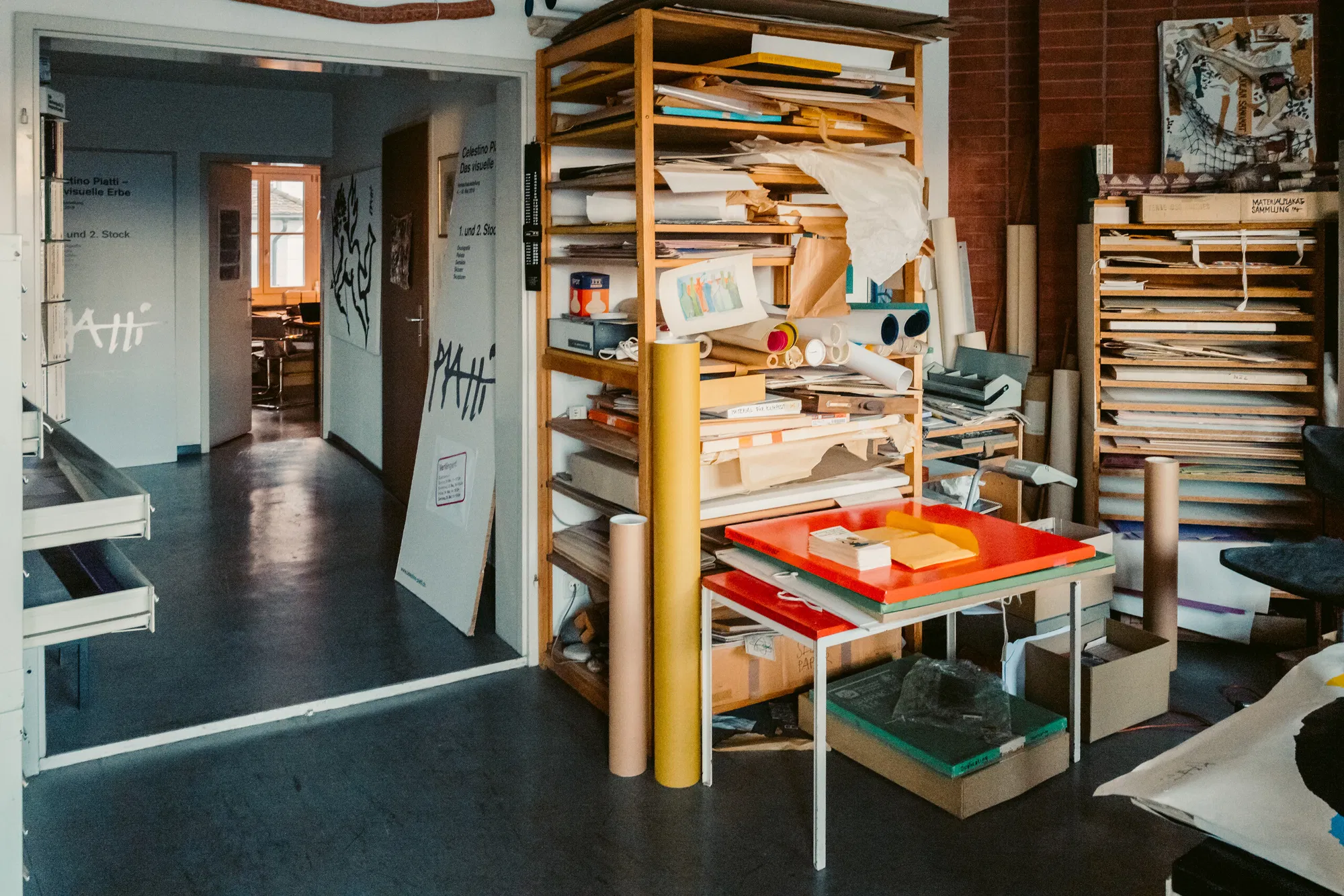
There are heaps of cardboard boxes in Celestino Piatti’s studio. Containing labelled portfolios by the dozen. The titles, “Women’s Association Basel”, “Mon Chérie” or “Pro Juventute”. Other boxes are marked with “used pencils”, “to be sorted” or very succinctly “rubbish”. The hairdryer that Celestino Piatti always used to dry the colours he had painted as quickly as possible so he could continue working, is still lying on the shelf. A Solis hairdryer, straight from the depths of the 1970s. Strewn around, paintbrushes, colour cards, inkwells, matchboxes, heaps of paper, little drawings and sketches. And owls, owls and more owls.
 © Janine Wagner
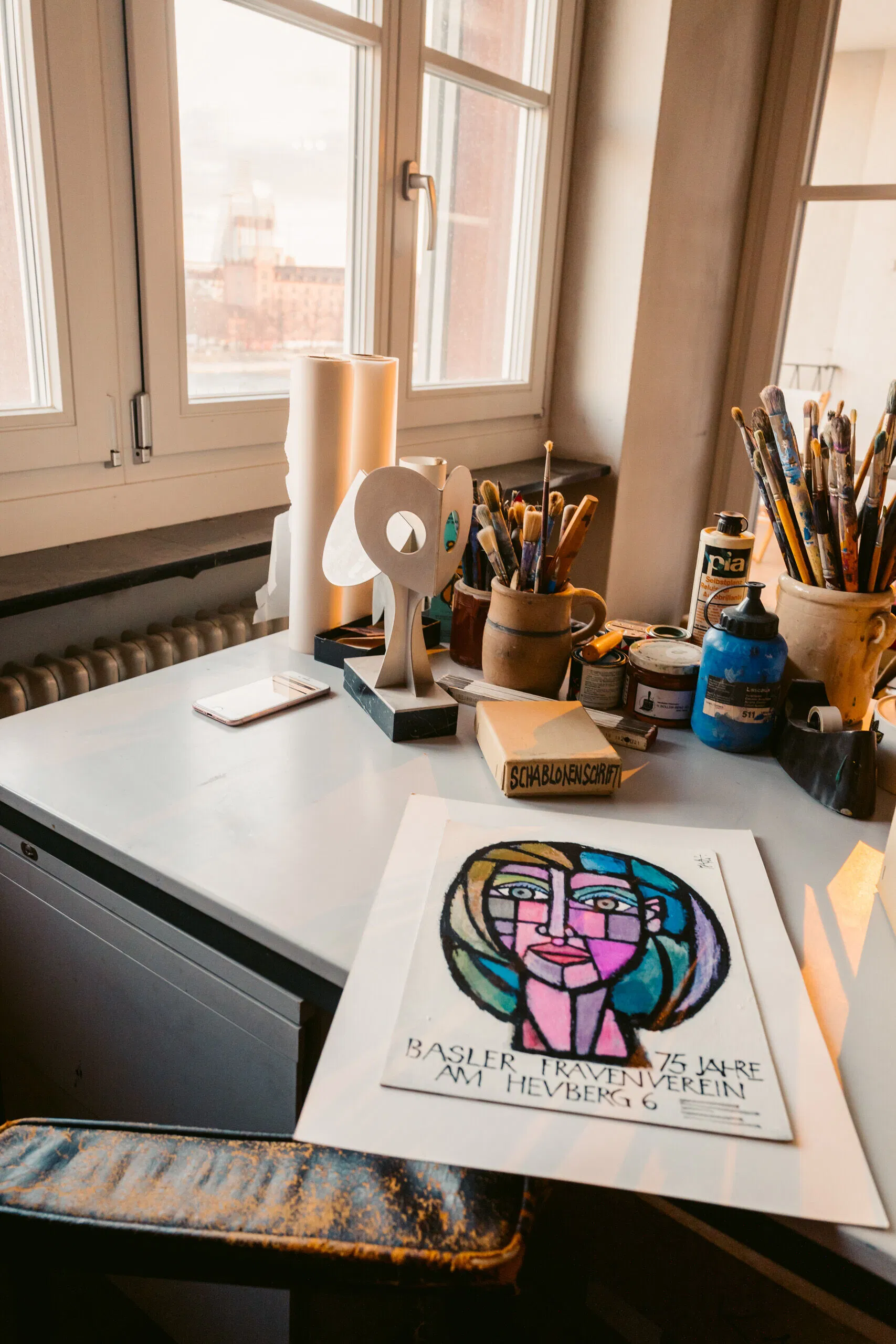
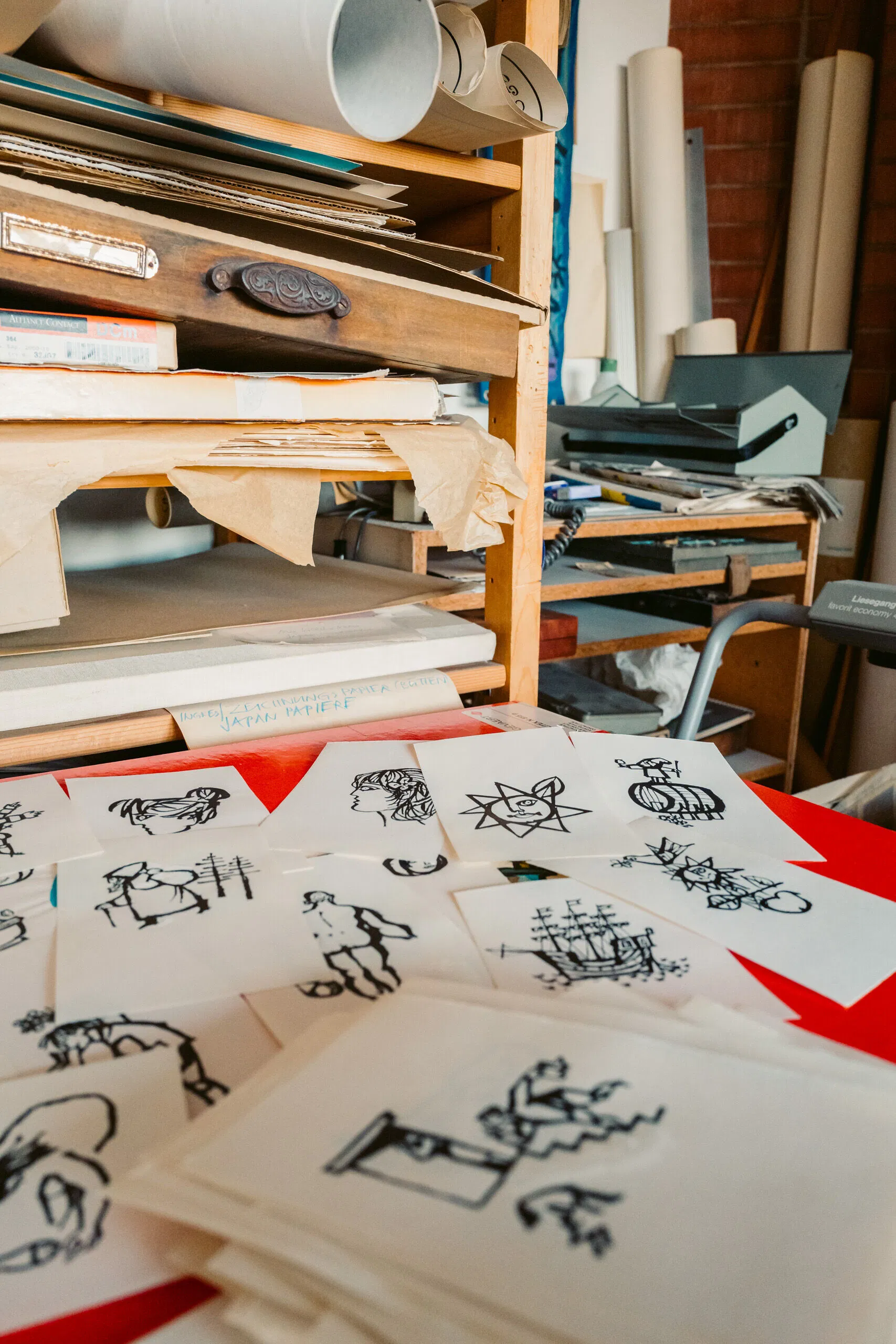
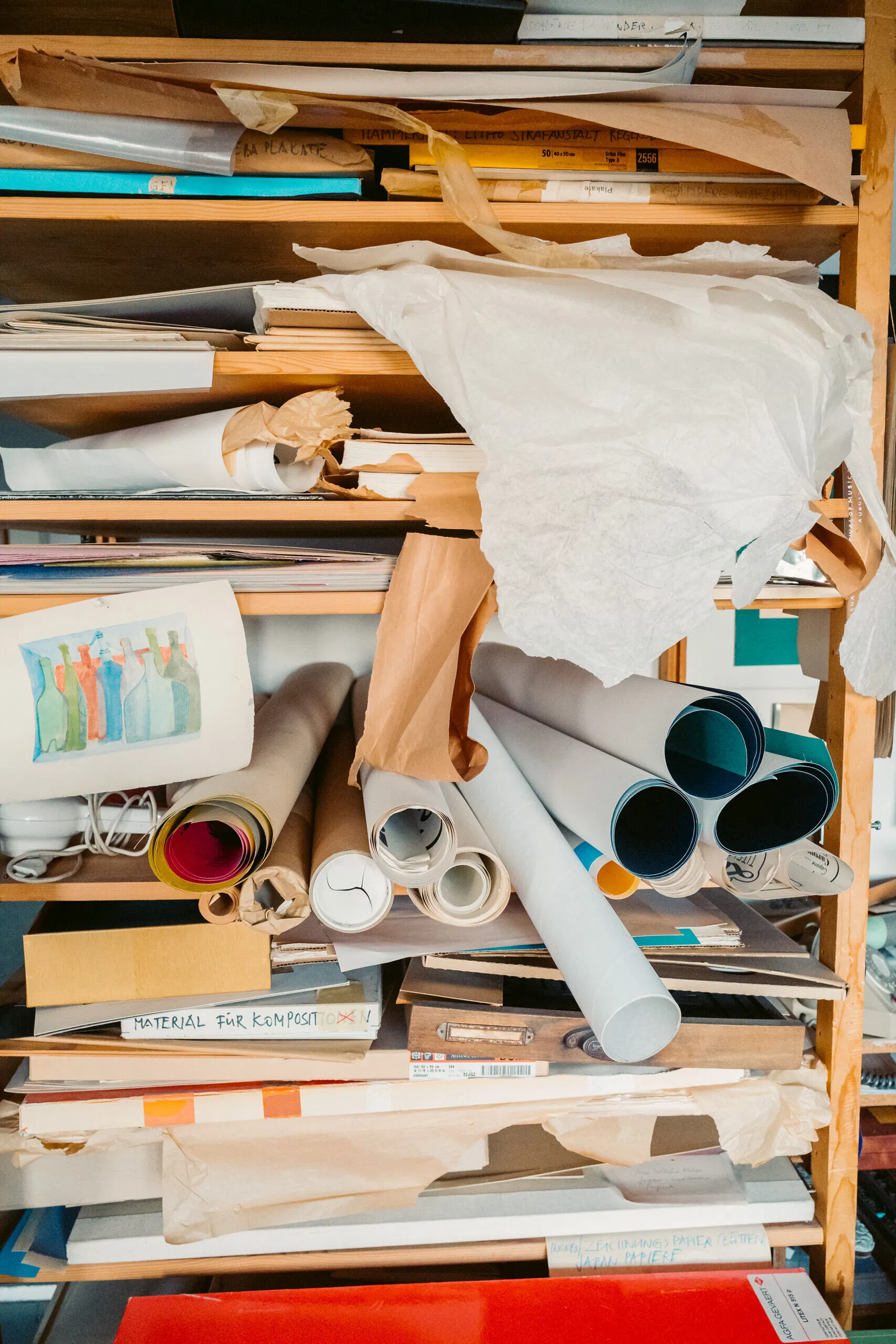
Celestino Piatti died 15 years ago. But in his studio, it looks as though he was still sitting here yesterday, on the worn leather chair pulled up to his desk, gazing at the Rhine, sketching and painting. When you walk into this room, you enter a treasure chest, although unfortunately it is not open to the general public. You can rummage in little pigeonholes, root around in boxes and comb through trays; constantly discovering something new, exciting or amusing.
Not even his family have looked through anywhere near everything. Neither in the studio in the St. Johanns-Vorstadt, which is packed full of things, up to the ceiling, nor in the old warehouse outside Basel containing countless drawings, lithographs, posters, sketches and letters. Celestino Piatti’s daughter Barbara constantly finds herself holding new pages, mementoes of her father and his career spanning almost 70 years. It is a cultural inheritance that she is currently working through with her family. And constantly delving back into her own past at the same time.
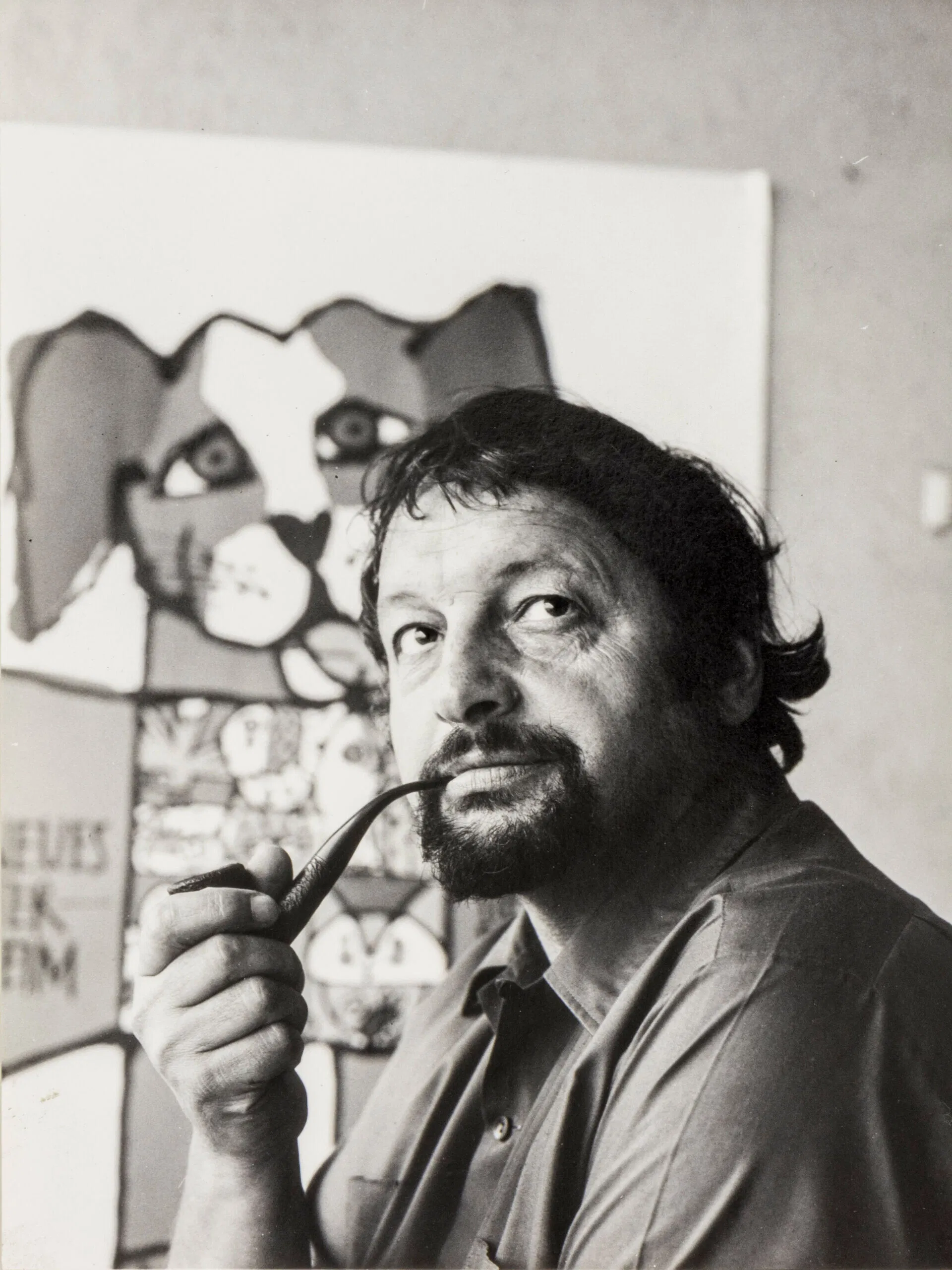
His last assignments were in 2005 – when he was 83 years old.
“Actually, he never stopped being productive”, explains Barbara Piatti during our conversation, “his last assignments were in 2005 – when he was 83 years old.” In January 2022 Celestino Piatti would have celebrated his centenary. In 2019 his family, with experts and friends, began to sift through and sort out his immense body of work. They founded an association, “Celestino Piatti – the visual heritage” with the aim of making the work of this internationally renowned illustrator and graphic designer available to the general public. There are still thousands of drawings, sketches, drafts and letters lying around unseen in neatly labelled boxes. Piatti’s legacy is absolutely vast.
It is quite staggering how productive he was.
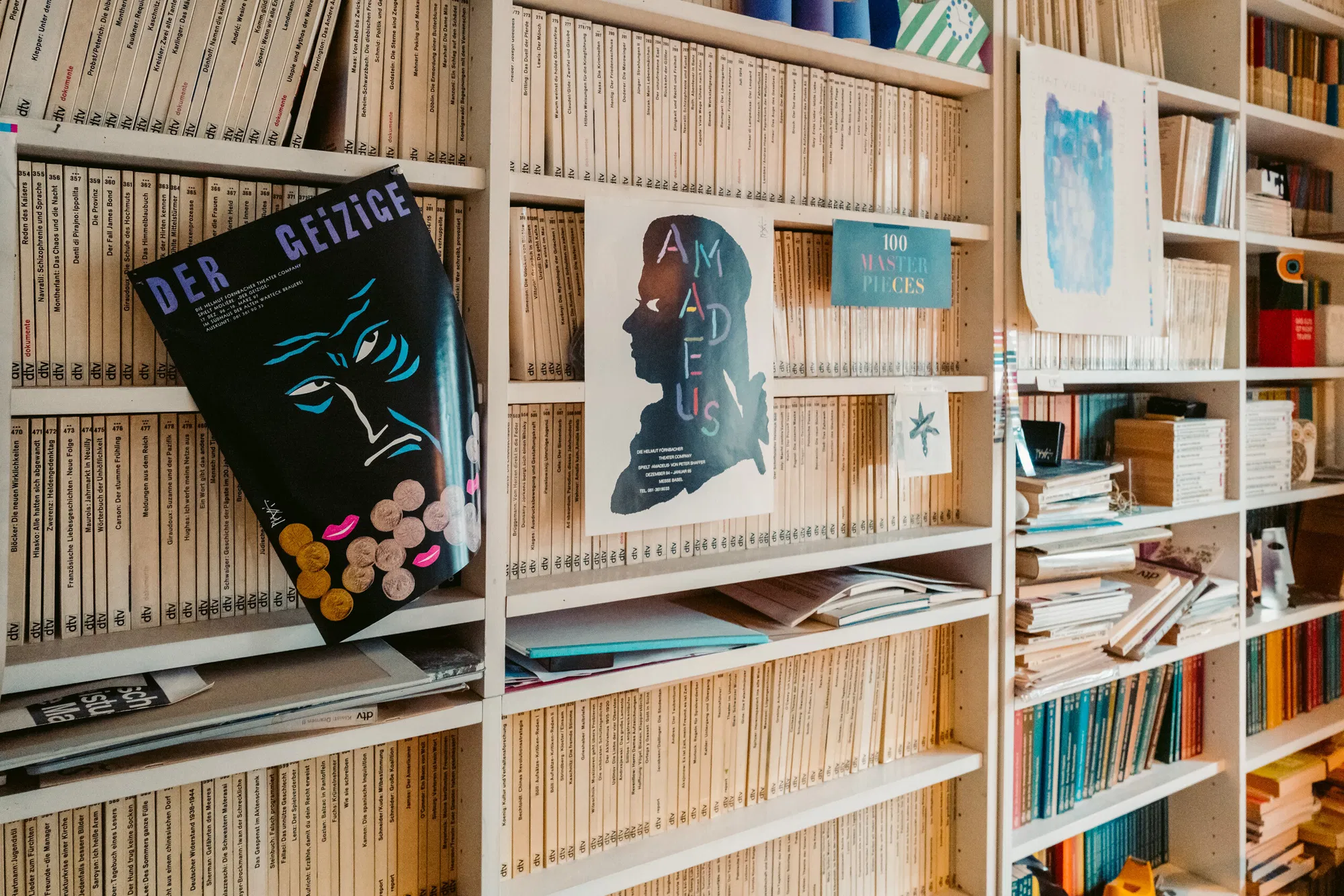
Celestino Piatti was a workaholic. Time and again he burdened himself with enormous workloads and deadline pressures, worked night shifts, made the impossible possible. “He loved his work to distraction and was unbelievably hardworking. But he was not a good organiser”, Barbara Piatti realises that now, with hindsight. “We are finding a lot of boxes where he has simply thrown in everything to do with an assignment. Sketches, correspondence, corrections and notes such as “submit an invoice?” – the sheer mass of his work meant that he often didn’t know whether he had sent a bill or not. Archiving, sorting out and planning were not his strong points. But it is quite staggering how productive he was.” At the same time, Piatti was a perfectionist. Even after 30 years of working at dtv he corrected even the tiniest details. He never let a single wrong word-spacing or wrong colour tone slip through. “Whereas you might think, my God, it’s the six-thousandth book cover, let’s just leave it”, his daughter smiles today.
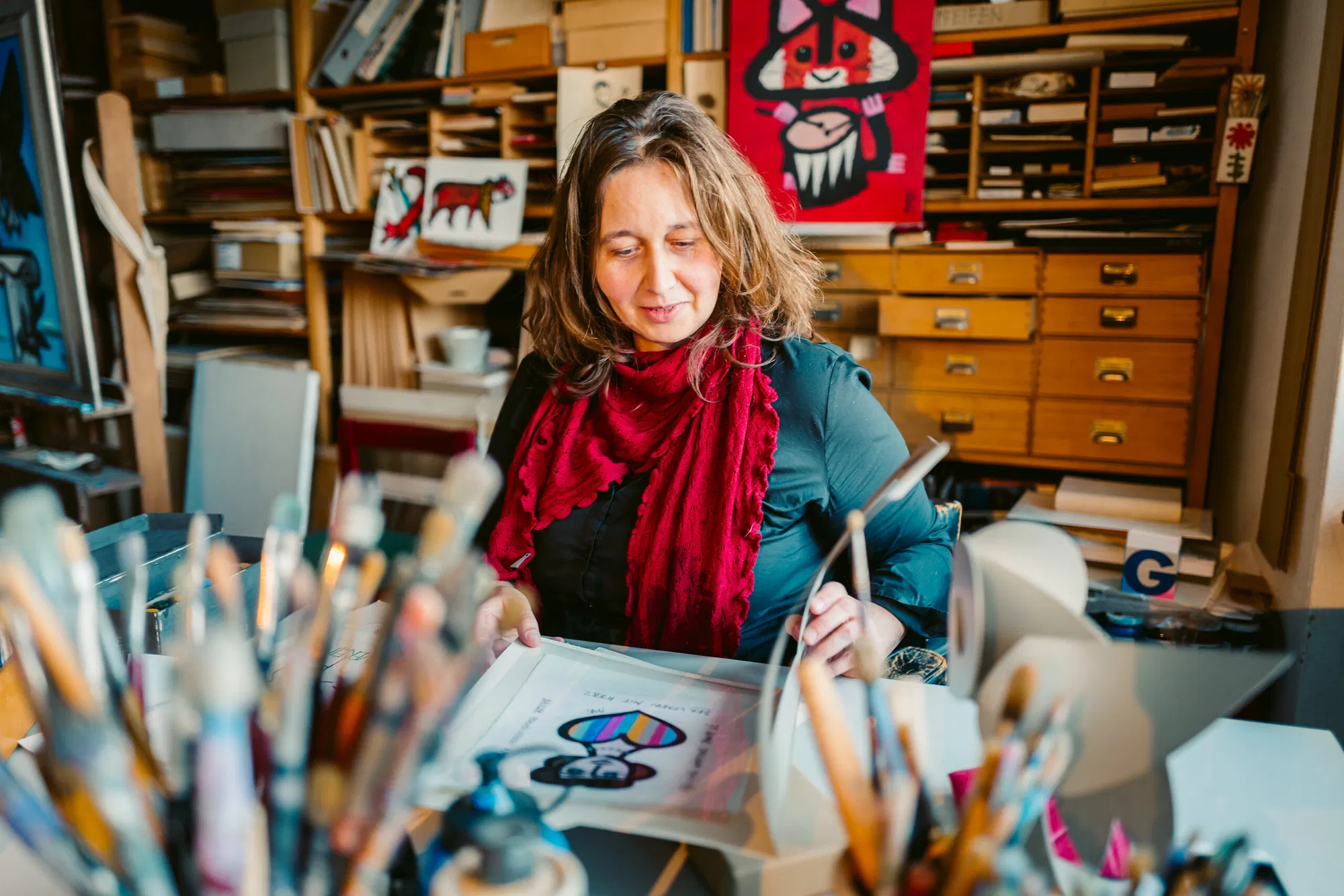
While telling us all this, she is constantly pulling out new sheets of paper covered in sketches and ideas. She herself is also seeing a lot of these things for the first time, she smiles, pauses, dives in again. She tells us, for example, about the legendary Café Spillmann in Basel, where her father and mother caught sight of each other for the first time and immediately fell in love. Or the smell of the glue Cementit, which still reminds her of her father today. About excursions and journeys. “My father always felt drawn back to the sea, to sketch”, she mentions. “There are an incredible number of drawings depicting ships, fishing boats and harbour scenes.”
 © Janine Wagner
 © Janine Wagner
 © Janine Wagner
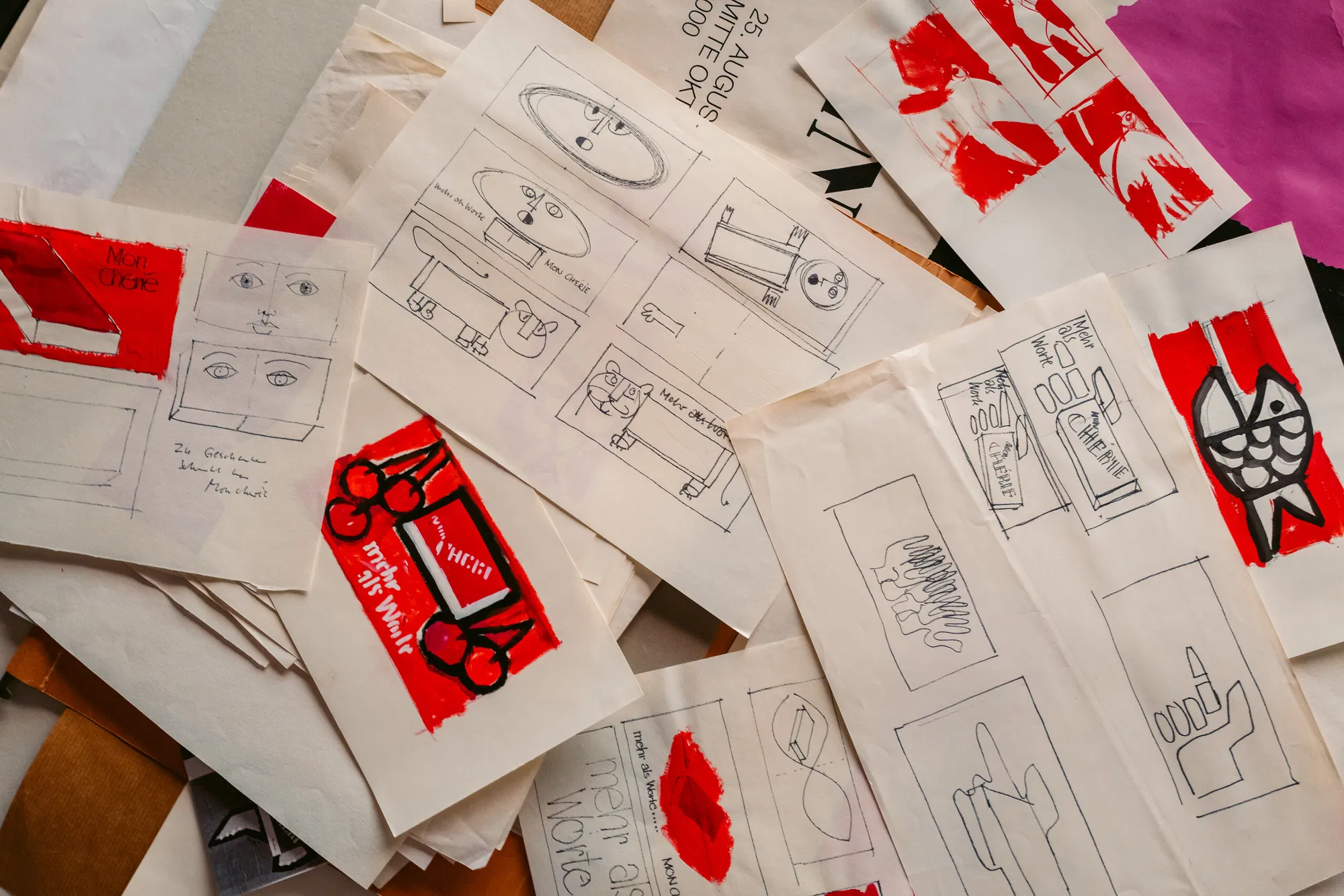
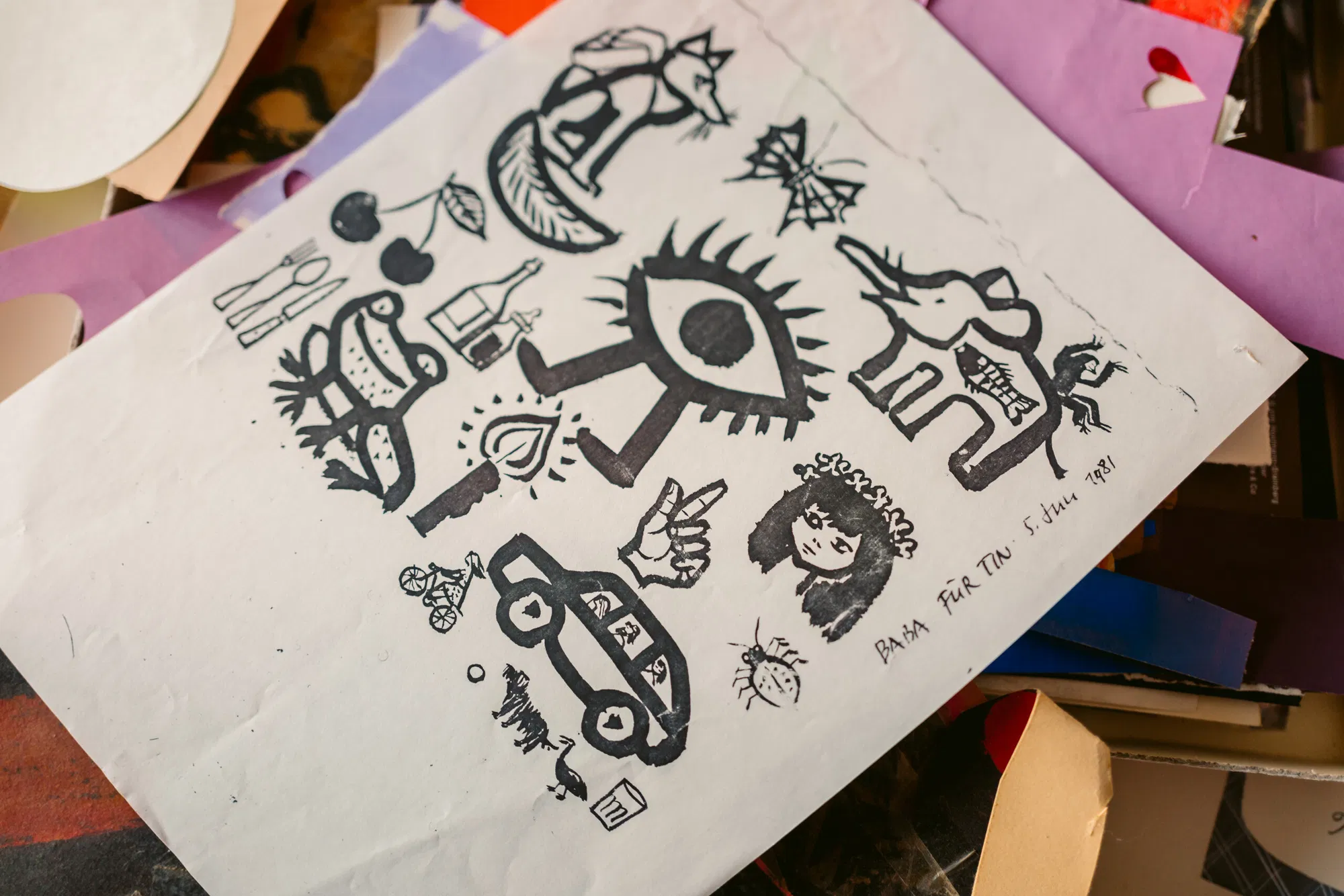
Behind each print were countless studies and drafts.
Barbara Piatti’s accounts create the image of a good-natured, modest man. A family man who enjoyed spending time with his children out in the countryside, who drew stories for them and for whom the door of his studio was always open. Although he accepted the fuss surrounding his person, he felt much more comfortable at his work table. And yet “although he mastered his craft better than almost anyone else, nothing just fell into his lap”, Barbara has now realised. “Behind each print were countless studies and drafts.” A glance into the Basel studio quickly reveals: Every stroke is still lying in a box somewhere or other.
Celestino Piatti’s posters, sculptures, books, lithographs, drawings and book covers have influenced people’s visual memories. His legacy is an artistic universe, immersing yourself in it awakens memories and is inspiring. The true scale of this universe – or the approximate number of Piatti’s owls – will probably never be fully appreciated, at least not by the general public.
The life and work of Celestino Piatti
Celestino Piatti was born on 5 January 1922, his father a stone carver from the Ticino and his mother the daughter of a farmer from Zurich. He trained as a graphic designer in Zurich and came to Basel in 1944 for his first and only position as a graphic designer in advertising. In 1948 – at the age of 26 – he already began to work as a freelancer. He started working on advertising for consumer products by Rolex, Campari, Knorr, Sandoz and Pfizer. But also for the campaigns for women’s right to vote, against atomic energy and against wearing fur. He felt the urge to employ his resources to further humanitarian causes and for the protection of animals and the environment. Between 1961 and 1992 he designed over 6,300 book covers for the dtv (German publisher) in Munich. In addition, he illustrated seven children’s books, held exhibitions, created over 500 posters. Piatti’s art is still famous and in demand all over the world. Celestino Piatti died on 17 December 2007. His three daughters and second wife all still live in Basel and the area around it. Several books have been published in honour of his centenary: An illustrated book on his life and work with the title “Celestino Piatti. Everything I paint has eyes”, a complete edition of his most famous story books (“Piatti for children”) and a special edition in several bands published by dtv.
 © Janine Wagner
 © Janine Wagner
 © Janine Wagner
 © Janine Wagner