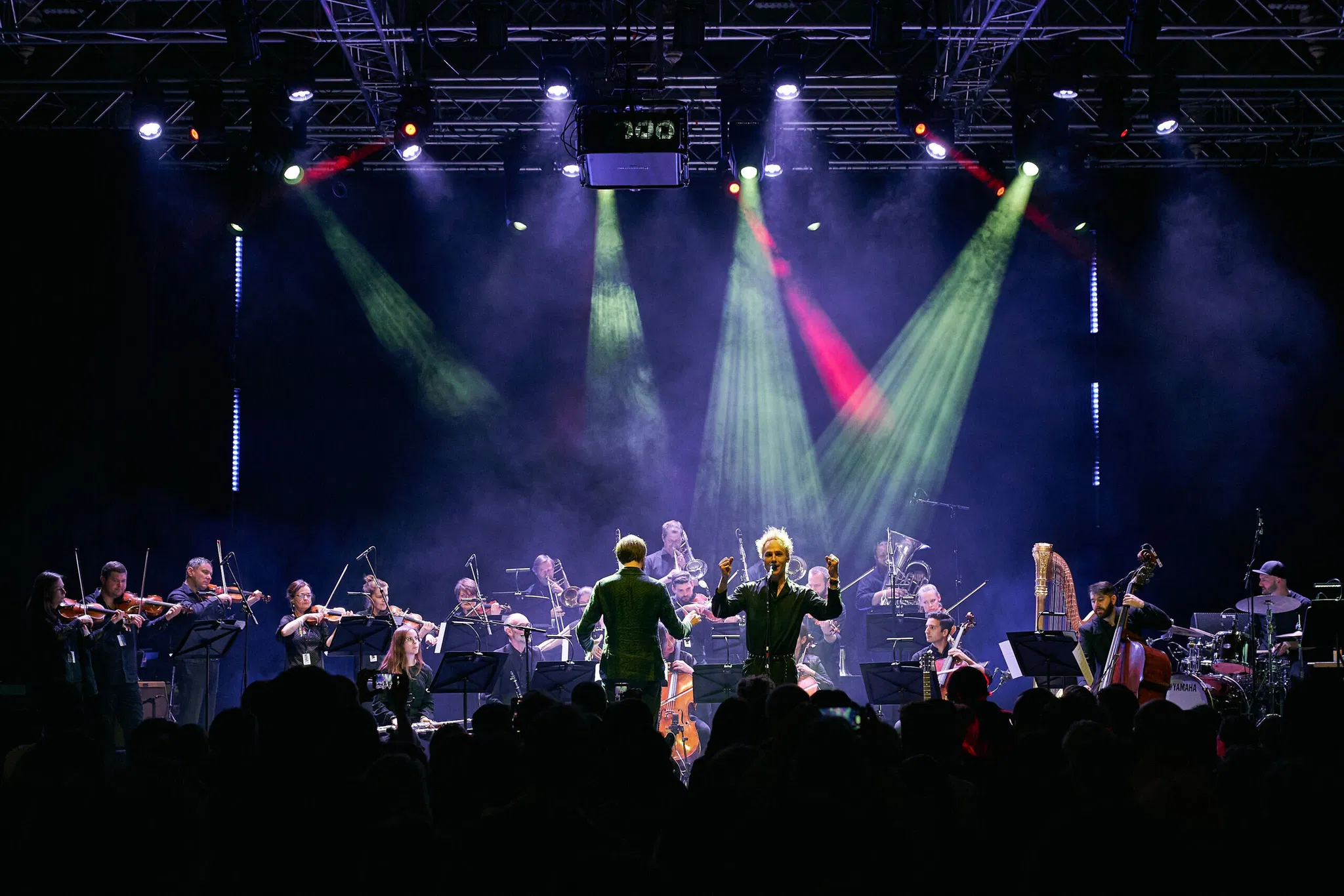
In an excellent mood and full of life, Sam Himself leaps onto the stage for the sound check. Behind him: 20 musicians from Basel symphony orchestra. The instruments are being tuned; positioning improved. “And the last step, the harp; sounds good, we can begin.” the sound engineer announces through the microphone.
First song: La Paz. The tears come straight to my eyes. Sounds cheesy. But it’s true. An orchestra amplified like this, combined with Sam’s deep, powerful voice, is really something. Not least the eight violins – wow! Every now and then there are corrections to be made; amplifiers turned down, then up a bit, “Fippe” (the drummer) “don’t drift off, okay!” Sam admonishes him, but in a friendly manner.
I had actually been expecting it to last two hours or so. But after only about 30 minutes, the singer from Basel enquired humorously: “Do you mind if we do another run-through of La Paz or would you prefer to chill? No worries, you sounded great, it's mostly for the singer.” So there’s another rendering of Sam’s dreamy hit from last year, before the orchestra members unobtrusively depart the stage again.
When the spark from the audience bounces back to the musicians, it's indescribable. That can only happen at live concerts!
In the interview that follows, Domenico Catalano (34), the bass trombonist, tells me why the rehearsal was over so quickly, what being on stage with Sam today signifies and how to become a professional musician in a symphony orchestra.
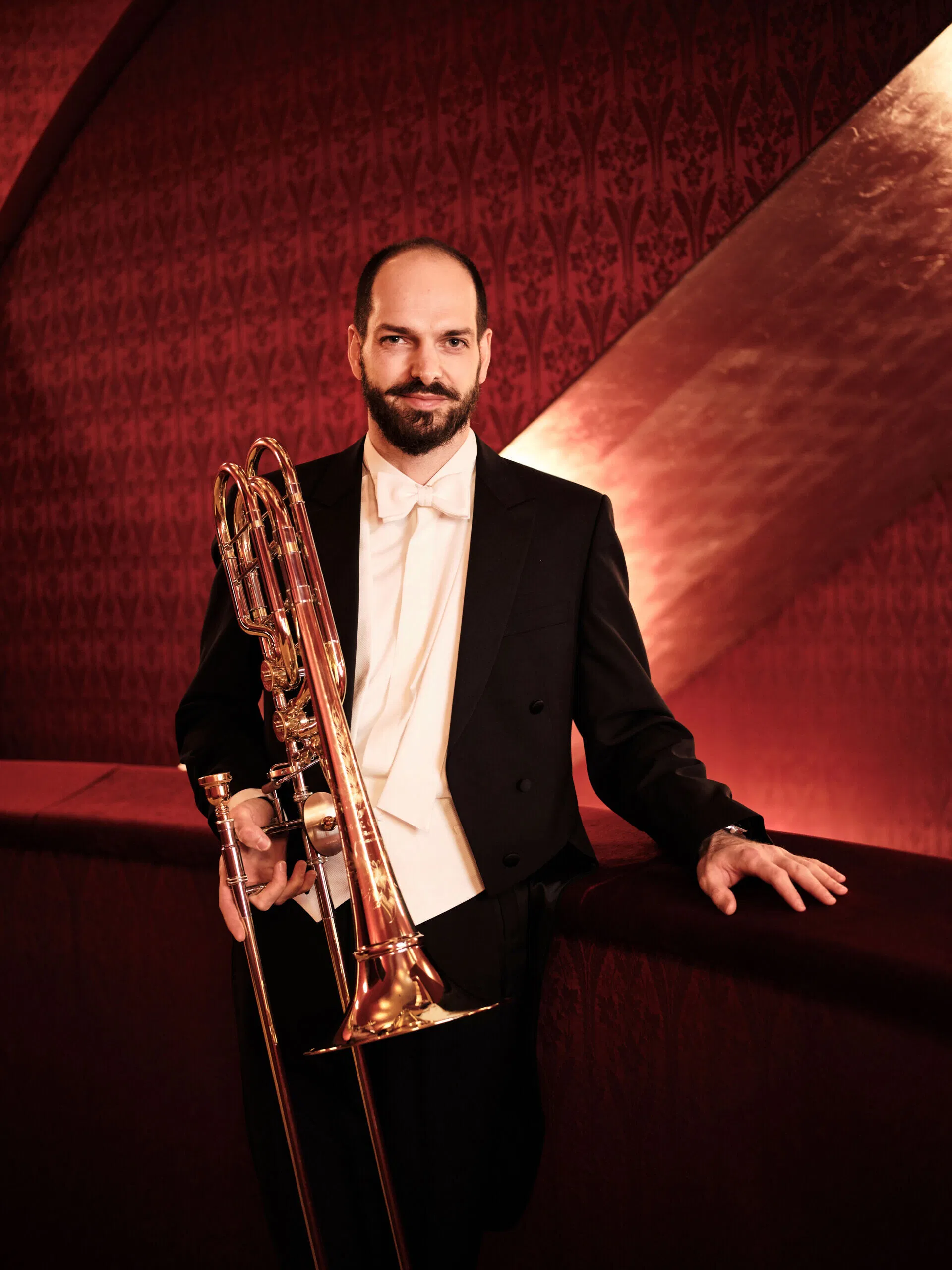
Domenico, that was over pretty quickly …
Yes, we thought it would take longer too. But it’s only four songs. You don’t have to drag the rehearsal out if it’s not necessary.
It’s incredible that today was only the second time you rehearsed together with Sam. When did you begin rehearsing by yourselves?
I personally only looked at the score for the first time a week ago. That might sound ridiculously overconfident, but it’s not the first time that I have worked with the arranger and director, Michael Künstle. I’m familiar with his style of writing, so I knew I was not in for any nasty surprises.
What I always wonder is: when you are a musician playing in an orchestra, are you thinking about anything while you’re playing?
No, I really don’t think about anything much. It’s more about being extremely concentrated on playing the music. You play with open ears; you hear every note your colleagues are playing. And of course, you have to make sure that you keep in tune yourself. Luckily, it’s extremely rare for notes to be off-key in the orchestra.
How does your concert with Sam differ from a classical concert? Are you a bit freer in how you play today?
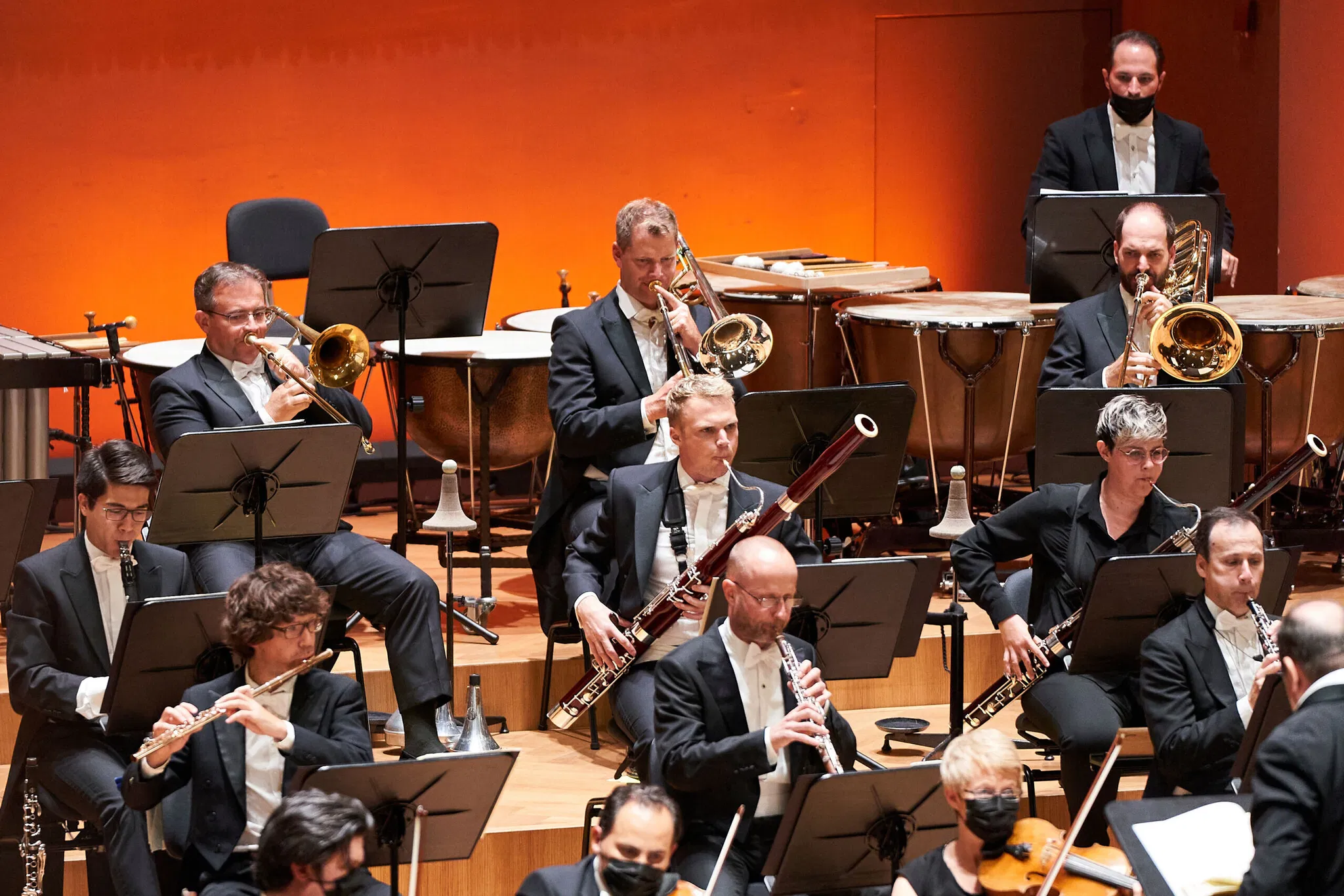
Yes, in a way I suppose. In a rock or pop concert, compared to a classical concert, there are hardly any lulls in the music. You have to adapt the way you play. And usually we don’t play standing up, but sitting down. The fact that we are being amplified is also a complete exception. But where we’re playing, in the Reithalle at the Kaserne, it is necessary. And the percussion from Sam’s band brings an added swing to the whole thing too. During the rehearsal, I was mainly busy trying to be aware of what all the musicians were doing, which was very difficult because of the amplification. This means you have to rely on the sound engineers. And as orchestra players we are not used to that; we don’t like handing over control to someone else, we prefer to influence as many factors as possible ourselves.
You are not only on the road with the Basel symphony orchestra, you also have your own innovative projects. Where do you feel more at home, in the world of classical music or of improvisation?
That’s a good question, but a difficult one. Of course, I was trained to play in a classical symphony orchestra. But even while I was still studying, I was always looking for ways of broadening my horizon. With my own projects, I am always trying to do something that has never been done before. I would like to present the bass trombone as an instrument in a different light; away from its image as a classical orchestra instrument or as part of a big band. In an orchestra, the framework is usually very clearly specified; the opportunities it offers to break out of the mould are pretty limited, a bit like high-performance sport perhaps: when a sprinter decides to compete in the 100 metre sprint, he doesn’t train to compete in the high-jump at the same time. So it is especially nice that I can participate in both worlds. As an orchestra musician, of course, I want to perform the great works as often as possible. That’s why we’re here. Each week is different. And it’s precisely this variety that I love so much about my profession.
When and why did you choose to learn the trombone, of all instruments?
When I was about six years old, I was lucky enough to witness a really impressive trombonist playing at a brass band concert. The way he played was incredibly relaxed but perfect. From that moment on, I wanted to be a trombonist. No question. It’s not that I come from a family of musicians.
And when did music become your profession?
I only realised that I could become a professional musician quite late in the day. I tried out a few different professions, but none of them felt right. Then one of my teachers said: Why don’t you study music? You can play trombone all day then. I didn’t even know that that was an actual option. I decided I wanted to attend the music academy in Lucerne, and I was hooked straight away. I’ve already been playing in the orchestra for ten years now.
How does the Basel symphony orchestra manage to reach a younger audience too?
Concerts like this one today with Sam Himself certainly help. But the audience in Basel, in comparison to other towns and orchestras, is basically relatively young anyway, which is lovely, but not relevant for me as a musician. For me most important thing is that I move my audience!
Do you have a musical dream that hasn’t come true yet?
Well besides Basel, there were always three other orchestras that came into question as far as I was concerned: the Berlin Philharmonic, the Vienna Philharmonic, and the Gewandhaus orchestra in Leipzig. Two weeks ago, I auditioned in Leipzig and I won. And now I am really looking forward to the next season. A dream that came true!
Wow, congratulations! What will you miss most about Basel?
What I appreciate the most in Basel is the diversity in its cultural life. Its openness – it was really not difficult to connect up in Basel’s cultural circles. And that includes between the different genres. As far as I have seen, other cities are much more reserved.
Basel Symphony Orchestra
In their own series of concerts, at Basel’s theatre, or in guest performances in Switzerland and abroad: Basel symphony orchestra – under the direction of its lead conductor, Ivor Bolton – enthrals its audiences, again and again.
The conductor and arranger Michael Künstle organised a concert together with Sam Himself at this year’s BScene music festival, which really got under the skin. In all, 20 orchestra musicians (of a total 100) appeared on stage with the successful musician from Basel.
Basel symphony orchestra has been playing at its own historic premises again since August 2020, namely the superbly renovated Stadtcasino Basel.